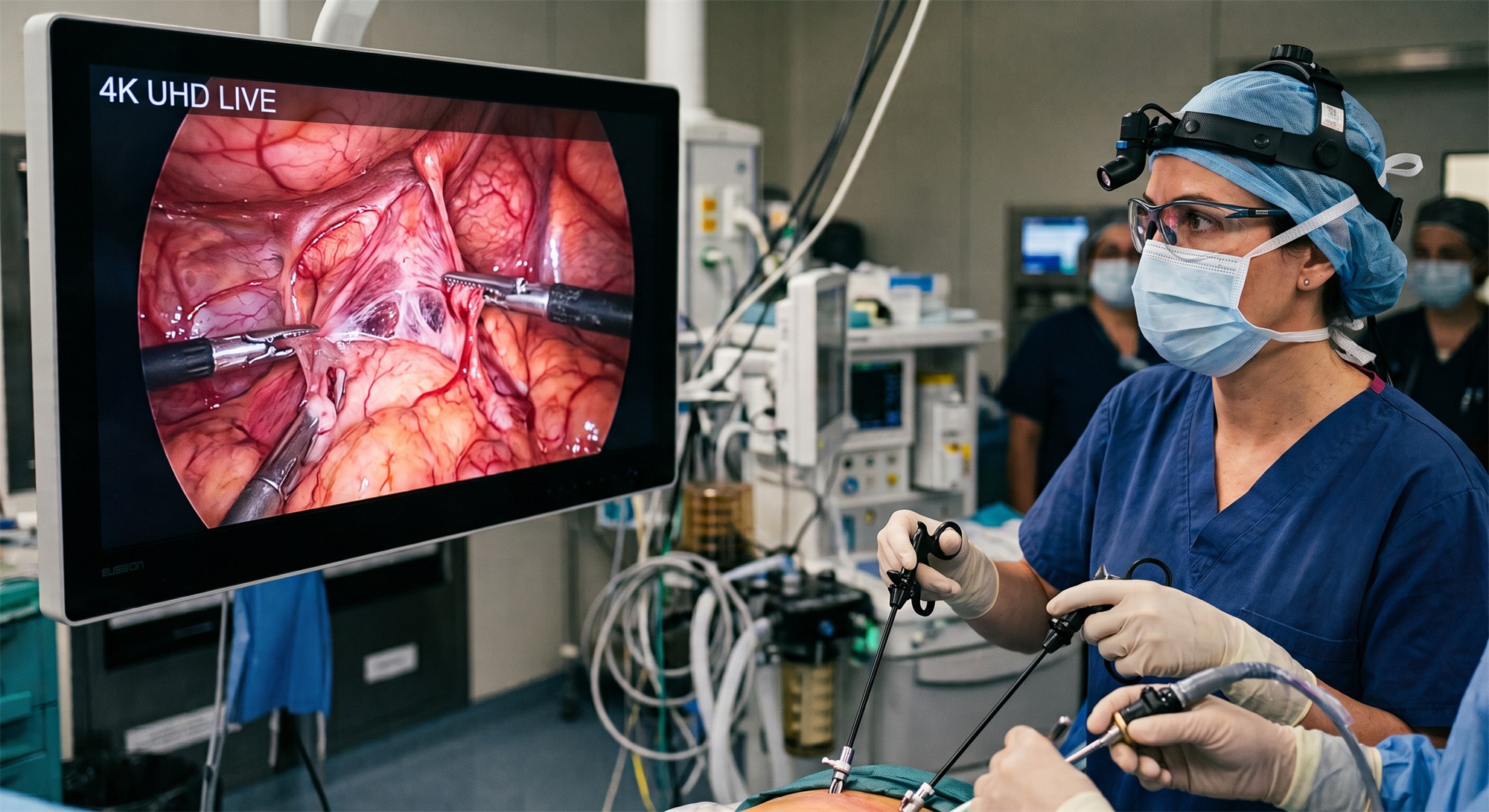
In the high-pressure, critical-care environment of the operating room, technology must be invisible. It must provide robust, consistent performance while allowing the surgical team to focus entirely on the patient. As more hospitals explore the transition to wireless video systems to reduce cable clutter and improve workflow flexibility in the OR, IT administrators and Biomed engineers are asking a critical technical question: Can wireless video truly match the video performance of a hardwired connection?
The answer lies in understanding the exact specifications that determine video performance. When evaluating a wireless video solution for the OR, three parameters separate consumer-grade technology from true medical-grade equipment: latency, image quality, and frame rate.
1. Latency: Uncompromising Hand-Eye Coordination
During minimally invasive procedures, such as endoscopy or laparoscopy, the surgeon relies entirely on the monitor to guide their instruments. Even a fraction of a second of delay - latency - between the physical movement and the on-screen visual can severely impair hand-eye coordination. This causes surgeon fatigue and, in extreme cases, jeopardizes patient safety. A true medical wireless solution must offer sub-frame latency. At 60 frames per second, each video frame represents approximately 16.7 milliseconds. Sub-frame latency means that the additional delay introduced by the wireless transmission is less than the duration of a single video frame. This guarantees that the wireless transmission feels and responds exactly like a traditional copper or fiber-optic cable, delivering real-time visual feedback.
2. Image Quality: Visual Acuity and Color Fidelity
To transmit high-resolution video (such as 4K) over the air, many systems rely on data compression algorithms. The danger here is that aggressive, lossy compression can introduce visual artifacts or subtly alter color gradients. In surgery, the ability to distinguish between minute shades of red can be the difference between identifying healthy tissue and compromised tissue. The ideal wireless system utilizes visually lossless compression. This maintains an accurate color gamut and pristine image detail, ensuring the surgeon sees a precise representation of the surgical site.
3. Frame Rate: Smooth and Natural Motion
Frame rate dictates how many individual images are displayed per second. In surgical video, especially when there is rapid camera movement within the body cavity, a low frame rate will create a choppy, stuttering image. This can induce motion sickness and severe eye strain for the surgical staff. For demanding surgical-video applications, support for 4K resolution at 60 frames per second provides both high spatial detail and smooth motion, even in congested hospital RF environments.
The Rocoto Difference: Uncompromising Wireless Performance
Knowing what matters is only half the battle; the other half is implementing a solution that actually meets these rigorous medical standards. This is exactly why Rocoto engineered the MD11 and MD62 connectivity solutions specifically for the surgical environment.
Unlike standard wireless transmitters that force a compromise between speed, image quality and robustness, Rocoto’s proprietary technology guarantees sub-frame latency, ensuring surgeons experience true, real-time hand-eye coordination. By utilizing advanced, visually lossless compression and supporting up to 4K30 on the MD11 and up to 4K60 on the MD62, the MD series delivers uncompromised color fidelity and perfectly fluid motion.
The Bottom Line
Hospital technical teams cannot afford to compromise on clinical safety or image quality. With Rocoto's MD11 and MD62, OR directors, Biomeds, and IT leaders can finally deliver the wireless freedom and workflow efficiency their clinical teams want, without sacrificing a single metric of performance.