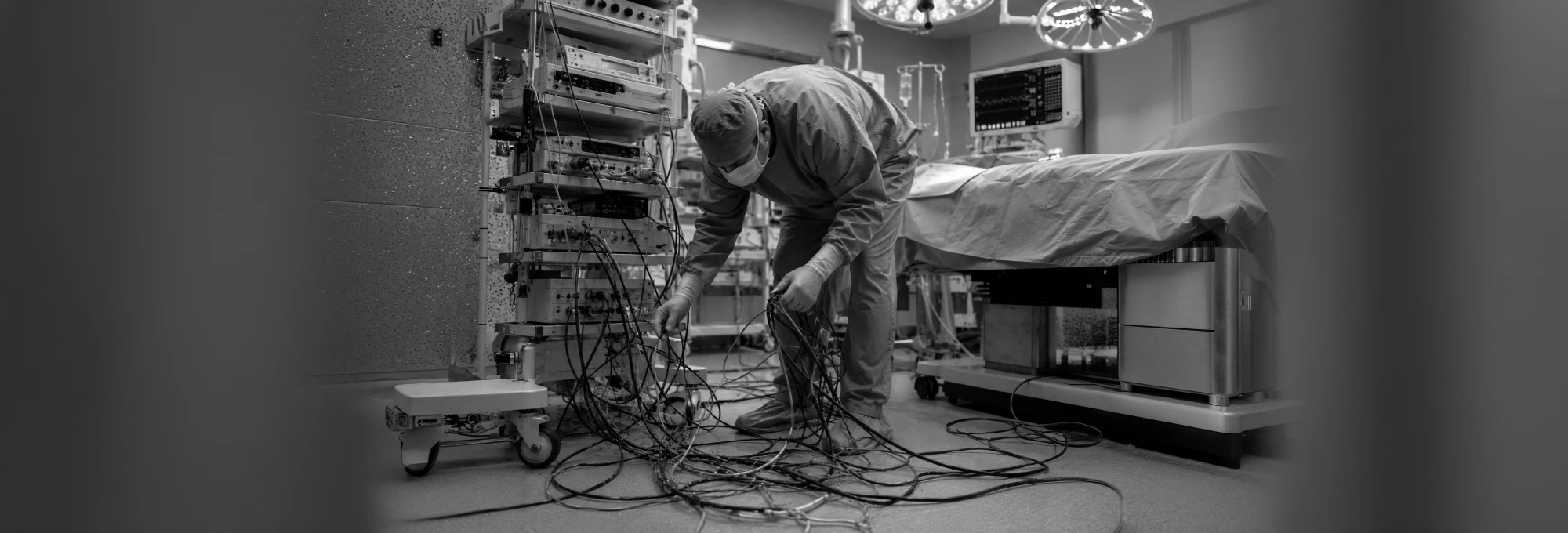
In the OR, every moment matters. Clinicians must have absolute focus on the patient and the procedure, but bulky video cables often present disruptions that threaten the efficiency of surgical workflows. Cable clutter presents trip hazards and other risks for clinician safety, and obstacles to efficient workflows.
For biomedical engineers, cable runs may dictate room layouts and slow down the transfer of equipment between procedural rooms. They can also interfere with crucial metrics that biomeds are measured on, such as service tickets, setup time, downtime, and replacement costs.
The challenge falls on biomeds to implement reliable, unobtrusive video solutions to keep clinicians safe and procedures on track. A breakthrough in true wireless video technology can help biomeds eliminate cable-related risks like the ones outlined here.
Cable Clutter Presents a Serious Trip Hazard
The risk of physical injury is the last thing that clinicians should have to worry about in the OR, but slips, trips, and falls (STFs) are an ever-present danger. A 2007 study revealed that STFs are responsible for around one fifth of lost-time injuries for healthcare personnel, with cords and cables as one of the three main tripping hazards.1
Ensuring that clinicians have a clear view of monitors in the OR is enough of a challenge for biomedical engineers, much less ensuring a clear view of the floor. Without a shift in design philosophy, cable clutter on the floor will continue to present a serious tripping hazard in the OR and other procedural spaces.
Cable Runs Limit Room Layouts
In an ideal world, procedural rooms would always be set by the case, not by the cable runs. The reality is that biomedical engineers are often limited by cables when arranging layouts, and clinicians are forced to work around the physical limitations of cords.
When monitors are not placed conveniently, clinicians face ergonomic issues that threaten to delay procedures. Consider a layout where the physician must crane their neck to see critical visual information on a nearby monitor. For a short procedure like a diagnostic laparoscopy, this inconvenient arrangement may be a minor annoyance. Over the course of a lengthy, hours-long procedure like laparoscopic surgery, fatigue and physical strain can become a real concern for the physician.
Cable Disruptions Threaten Clinical Workflows
Studies have investigated the impact of “Flow Disruptions,” or FDs, in surgical settings.2 FDs are defined as “a deviation from the expected progression of the surgery thereby potentially compromising safety or efficiency.”3,4 Researchers found that FDs occur every 5–7 minutes during a procedure, on average, with device malfunctions as a contributing factor.5–7
For video cables, both physical and electrical disruptions can lead to Flow Disruptions to workflows in the OR. Broken cables are common, and surgical teams may accidentally unplug equipment due to cable clutter on the floor.
Wires Hinder the Movement of Shared Equipment
Wired equipment doesn’t just slow down clinical workflows in a single room. Many hospitals share mobile equipment like endoscopy towers between multiple suites, requiring transport in between procedures. Here, bulky cables threaten to hinder both teardown in one room and setup in another.
Between unplugging and wrangling video cables in the original room, managing bulky cords along with the mobile equipment, and navigating the new room’s cable runs to get the equipment plugged back in, transferring shared equipment can be a time-consuming ordeal for biomedical engineers.
True Wireless Video: How Biomeds Can Eliminate Cable-Related Limitations in the OR
Video cables present significant challenges in operating rooms and other procedural spaces. Bulky cords put clinician safety at risk, threaten efficient workflows, limit room setup and OR flexibility, and may disrupt time-sensitive surgical procedures.
Many biomedical engineers have evaluated wireless video solutions and found them to be an inadequate fit for the demands of the modern operating room due to video compression, significant latency, signal dropouts, and other compromises. Thankfully, a breakthrough in wireless video technology has given biomeds a reliable cable-free solution, purpose-built for the OR.
Rocoto is a pioneer in true wireless video solutions, built to meet the world’s highest medical standards. With true wireless video, biomed engineers can replace every cable between their medical devices and displays with a certified, zero-latency wireless link. Rocoto’s solutions are purpose-built for the modern operating room, and are both FDA-cleared and MDR-compliant.
The result is a safer, more efficient operating room free of cable clutter, without compromising the reliability surgeons depend on. With true wireless video, biomeds can rely on:
- Superior Surgical & Procedural Visibility: Confidently create the right view for each clinician.
- Efficient Clinical Workflows: Implement the right layout for the procedure.
- Clinician Safety & Ergonomics: Create the right arrangement for clinician comfort, not limited by cable runs.
- Uninterrupted Procedures: Improve the efficiency of care with reliable, zero-latency video transmissions.
- Simple to Deploy & Support: Easily implement the right upgrade path for every room without construction or downtime.